"Being smart doesn't make people infallible. It just makes them more dangerous."
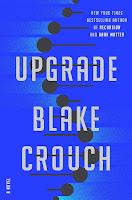
It is finally here! Blake Crouch's Upgrade was one of my most anticipated reads of the year, especially given how much I adored his previous two novels Dark Matter and Recursion. If you haven't already read them, go ahead and add both of those to your TBR list too. His publisher sent me an advanced copy of this latest book months ago, and I read it lightning fast. I've been not so patiently sitting on my review ever since. As it publishes today, I can finally share my thoughts and encourage you to read it yourself.
The novel opens in the not-too-distant future, a world that has seen today's pressing problems such as climate change, pandemics, and widespread starvation amplified to crisis levels. Logan Ramsay is an agent with the Gene Protection Agency (GPA), a federal organization tasked with upholding the laws against modifying DNA. The banning of this practice came in the wake of a well-intentioned, mass-scale genetic alteration that triggered tragic deaths across the globe. Simply put, in the wrong hands, adjusting an individual's biological nature on the molecular level has the potential to be weaponized by terrorist organizations. Logan and his team are raiding an illicit genetic lab when they trigger a trap and are shocked by a large explosion.
When Logan wakes, he sees the extent of his injuries. Tiny cuts envelop his entire body. The GPA places him into quarantine, worried less by the injuries than by the potential that Logan was infected by a rogue virus meant to alter his DNA. After days under constant observation, he is released from the hospital, assured that no virus made its way into his body. It is during his recovery at home, however, that Logan begins to notice subtle signs that contradict that assertion. It begins as he beats his daughter at chess, a rare occurrence in his household. Soon Logan can think clearer, recalling minute details from his past with ease. His body changes too. Logan is plagued by intense aches as his bones become denser, his muscles strengthening with each sleep. More startling is his ability to process large amounts of new information, becoming an expert in moments. This new mental acuity sees Logan eager to reckon with his past, a time that saw invigorating progress but devasting results.
I don't read a ton of science fiction. In fact, I often find works in the genre to be difficult to absorb. Blake Crouch, however, has become the exception. He's long been one of my must-read authors, and Upgrade only further validates this status. The novel imagines a world where adjustments to DNA can amplify traits or characteristics within a person. Crouch daringly shines a light on humanity's apathetic approach to dealing with a global crisis and employs his fiction to propose and question the bold solutions that could be on the horizon. There isn't an easy way forward, and Crouch's novel veers into the moral ambiguity that comes with tackling the complexity of issues on a global scale. He has a knack for layering intricate concepts into a breakneck thriller that unrelentingly propels the plot forward. At the heart of Upgrade lies a cast of characters who ground the futuristic world through universal themes of family, love, and loss. It is in these nuanced characters that the true brilliance of Crouch's storytelling comes alive, drawing the reader deeper into the world he builds, one mind-blowing page at a time.
For more information visit the author's website, Amazon, and Goodreads.
(2022, 30)


