Showing posts with label Ian McEwan. Show all posts

What We Can Know by Ian McEwan

8 Comments »

What can we know? The answer depends, of course, on what it means to truly know something. History’s greatest thinkers have wrestled with these questions, circling the very foundations of existence. To that list we can now add author Ian McEwan. Best known for his modern classic Atonement, McEwan’s body of work reflects the eclectic interests of a writer as skilled at spinning a story as he is at probing life’s most profound questions. I’ve read Atonement and a handful of his other novels, though not as many as I’d like, so when his publisher offered me a copy of his newest work, fittingly titled What We Can Know, I was eager to dive in. Could McEwan shape such a lofty question into a novel? Could he balance philosophy with the intimacy of the human experience?

The novel is a work of historical fiction, though the history in question is less about the distant past and more about our present moment. The year is 2119, and academic Thomas Metcalfe devotes his research to understanding life in the early 21st century. For us, that means the familiar ground of the mid-2010s. But for Thomas, it’s a vanished world, long reshaped by climate change, war, AI, and illness. While his society exalts science and technology, Thomas insists that the true lessons of humanity endure in the arts. His obsession centers on a vanished work of poetry. The poem in question is A Corona for Vivien, a sequence of ten sonnets as famous for its mystery as for its beauty.

The poem was first recited in 2014 by poet Francis Blundy, performed as a birthday gift for his wife, Vivien, at a dinner party among friends. The only written copy was entrusted to Vivien herself, but it disappeared soon after and was never published or preserved. History remembers it only through the recollections of those who witnessed its fleeting debut. Determined to unravel its fate, Thomas begins digging into the lives of the dinner party’s guests, uncovering secrets of love, rivalry, and betrayal. As he delves deeper, he inches closer to the truth, not only of the lost poem but of the hidden meanings and fragile humanity it may still carry across the centuries.

If my attempt at summarizing What We Can Know feels scattered, that’s only because the novel itself is vast and sprawling, brimming with big ideas that resist neat categorization. At times I was captivated, at others overwhelmed, sometimes both within the same few pages. The story is anchored by a simple quest for a missing poem, yet that search opens into a sweeping meditation on memory, knowledge, and legacy. McEwan reminds us how much of what we believe about the past is filtered, distorted, or lost, even as our access to information has never been greater.

The further I read, the more demanding the novel became, but that rigor felt intentional. Its characters are layered, flawed, and often difficult to like. Its plot sprawls, loops, and challenges the reader to keep up. But beneath that complexity lies McEwan’s central theme. What we can know will always be colored by the subjectivity of the people doing the knowing. Life is messy, sometimes tragic, and unpredictable, but it's shaped by our unshakable drive to learn, remember, and seek meaning. That desire, McEwan suggests, is what defines us, and perhaps what allows a fragile sense of optimism to endure. In the end, What We Can Know reminds us that knowledge is never absolute, but the act of seeking it is what makes us human. 

For more information, visit the author's website, Amazon, and Goodreads

(2025, 75)

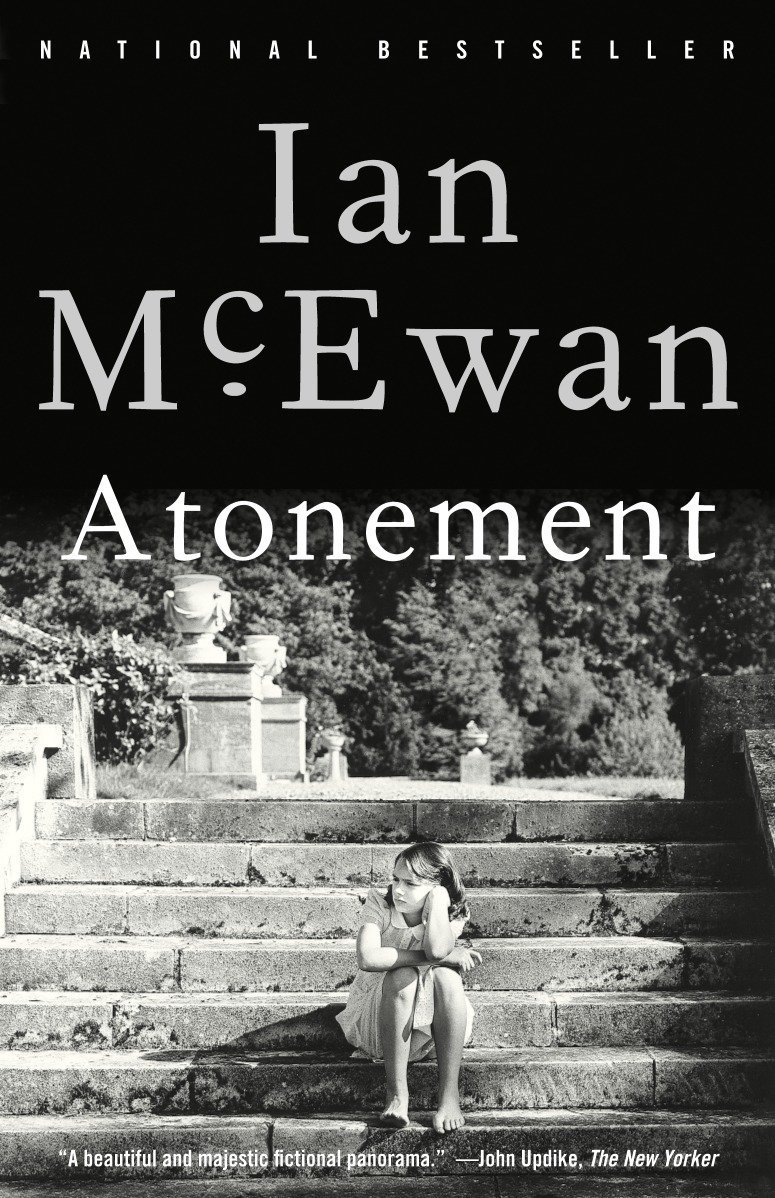
Atonement by Ian McEwan

6 Comments »

“How guilt refined the methods of self-torture, threading the beads of detail into an eternal loop, a rosary to be fingered for a lifetime.”

I'm always shocked and a bit ashamed at the sheer number of books that I acquire but never read. Even as I set out to write this review, I'm staring at a pile of 9 books that I received in the last couple of weeks. Despite my best intentions, I'll never be able to read them all. There just isn't enough time. Last week we set out for a cruise to celebrate my birthday. I was excited about getting away from work for a week to just relax, but I was even more hopeful that with all the extra time on my hands I would be able to devote hours to reading. As I packed a mix of several different books for the trip, I came to Ian McEwan's novel Atonement. It has been set on my shelf for over a decade, patiently waiting for the day that I would finally remove it and give it the read it deserves. Well my friends, I finally did it. I packed the book in my backpack and read the entire thing. 

Thirteen-year-old Briony is as precocious as she is imaginative. On a hot summer day in 1935, she has set out to present a play that she's written as a welcome home gift to her older brother. She hopes to impress him while encouraging him to eschew the single life in favor of settling down with a wife. Naturally, Briony intends to be a bridesmaid on the blessed day. In her eyes, there is no better way to achieve this goal than through a self-written and directed drama. Her visiting cousins, whom Briony has tasked with performing the great work, are not as keen. It is during yet another break from rehearsals when Briony spots her sister and the servant boy seemingly arguing down in the yard by the fountain. She isn't certain of the details of their apparent entanglement, but this does little to stop Briony from beginning to concoct the plot of her next drama. 

After Robbie and Cecilia have a row by the fountain, he storms off to his room. He's come to the conclusion that he simply can't go on lying to himself about the way he feels about the girl. Yes, they come from different classes, but he loves her. Robbie is determined to express his feeling to her. In a mad fury, he agonizes over pen and paper, writing out numerous drafts of his confession to her. One more colorful iteration of the confession sees the young man write of his lustful desire for Cecilia in a graphically detailed manner. With that out of his system, Robbie finally settles on a letter to her and seals it in an envelope. He tasks young Briony with delivering the note to her sister and breathlessly awaits a response. 

As any good little sister would do, Briony opens the letter before handing it off to Cecilia. She is shocked at the crude and perverse language with which Robbie used to describe his desires (clearly he sent the incorrect draft of his letter). Things come to a head that night as two children in attendance at her brother's return party go missing. Briony knows the kind of monster that is present at the gathering. As a search for the missing ensues, she dashes off to a remote part of the property where she interrupts a rape in progress. The quick and shocking nature of what she finds is made only murkier by the dark night sky. But at this point, Briony is too committed to the narrative in her mind to stick to the facts. She unequivocally tells of how she saw Robbie committing the crime, setting into motion a future built upon the follies of a child unaware of the magnitude of her naive convictions. 

On the surface, the main characters in Atonement can be kind of hard to connect with. In the opening chapters, as the young Briony set into motion a horrific lie that ruined the life of her sister and the man who loved her, I couldn't help but feel like each of them brought their own misery onto themselves. Yes, the girl lied about what actually happened, but the elder characters didn't do themselves any favors. It is in the second half of the book when author Ian McEwan shows the characters dealing with the ramifications of that fateful night that I found true empathy for each of them. We've all done something that has left us racked with guilt. Some people spend their whole lives trying to make up for a single moment. McEwan writes in unassuming prose that invites the reader to feel the emotion of each character. I was surprised at how moving the novel ultimately ends up being. There's a universality to the message of this work that pierced my consciousness, forcing me to reckon with my own shortcomings and mistakes. That such a simple story can have such a profound impact on the reader only further proves McEwan's dazzling ability. I'm certainly thankful to have finally dusted up my copy of Atonement

For more information visit the author's website, Amazon, and Goodreads

(2022, 15)


Powered by Blogger.