Showing posts with label Future. Show all posts

Bonded in Death by J.D. Robb

14 Comments »

Nora Roberts was a constant presence in my home growing up, with many of my earliest memories of my mom reading involving one of her paperbacks in hand. Despite being well aware of her work, I had never actually read one of her books myself. Under the pseudonym J.D. Robb, Roberts has been writing the In Death series for decades, and as a fan of murder mysteries, I figured this long-running series would be the perfect place to start. When her publisher offered me a copy of Bonded in Death, the 60th installment, I was excited to finally take the plunge.

Decades ago, Giovanni Rossi belonged to a secretive organization known as The Twelve. The Urban Wars were a time of chaos, but Rossi had long since left that life behind, settling into a peaceful existence in Rome with his wife. Yet, his ties to The Twelve were never truly severed. When an urgent call from an old comrade came, he had no choice but to answer. Rossi landed in New York, stepped into a waiting car—and was dead within minutes.

Lieutenant Eve Dallas is baffled by the case. There’s no clear evidence, no witnesses, and even the most advanced technology turns up nothing. She’s at a dead end until a link to the Urban Wars of the 2020s surfaces, leading her to an unexpected connection—Summerset, a longtime confidant and former wartime medic.

Summerset’s reaction to the crime is immediate and deeply personal. He confesses that he, too, was once part of The Twelve, a past he has spent decades trying to forget. But now, with a killer methodically hunting down its former members, he has no choice but to confront old ghosts. A chilling message makes one thing clear: others have already fallen, and the mission isn’t over yet.

As I began reading Bonded in Death, it quickly became clear that I had some catching up to do if I wanted to fully appreciate J.D. Robb’s long-running In Death series. Set in a futuristic world brimming with advanced technology and urban innovation, the novel offers a setting that modern-day investigators could only dream of. While Robb provides enough surface-level context for new readers to follow along, I couldn’t shake the feeling that having prior knowledge of the characters and their relationships would have deepened my connection to the story. That said, I was immediately drawn into the mystery at the novel’s core. The blend of espionage, suspense, and a seemingly impossible case made for a compelling read that kept the plot moving at a steady pace.

What surprised me most was the humor woven throughout the narrative, bringing moments of levity even amid high-stakes tension. The novel ultimately builds to a satisfying conclusion, even if the resolution isn’t entirely shocking. While jumping in at book 60 may not have been the ideal way to experience this series for the first time, I can see why these characters and this world have captivated readers for decades.

For more information, visit the author's website, Amazon, and Goodreads

(2025, 12)

The Morningside by Téa Obreht

16 Comments »

Téa Obreht has been a fixture in the literary landscape for as long as I can remember. I recall when I first began blogging about books, her debut novel, The Tiger's Wife, was on everyone's reading list. Like many instances since, I eagerly purchased the book, caught up in the excitement, only to let it languish unread on my shelf. There it remained, untouched, a silent reminder of my tendency to be swayed by the latest literary trends. While perusing the new arrivals at my local library, I recently stumbled upon Obreht's latest offering, The Morningside. Once again, I was drawn to the allure of a shiny new title, conveniently overlooking the neglected books waiting for me at home. This time, I made a conscious decision to follow through. Over the course of several days, I immersed myself in the pages of The Morningside, finally experiencing Obreht's writing firsthand. 

In The Morningside, the eponymous building stands as a symbol of faded grandeur, a once opulent high-rise now fallen into disrepair. Set in the not-too-distant future, the story unfolds in a world ravaged by the effects of climate change, where a Manhattan-like city has succumbed to flooding and a dwindling population. In response to these challenges, the government has devised a repopulation program, recruiting refugees with promises of a secure future within the city's confines. Despite these assurances, the anticipated influx of residents and laborers has yet to materialize, leaving the National Bureau of Posterity to advocate for patience and perseverance in the face of uncertainty. The echoes of past glory still linger, fueling hope for a resurgence of prosperity on the horizon.

In this building, we encounter Silvia, an eleven-year-old newcomer who resides with her mother. Encouraged by her mother to assimilate into their new surroundings, Silvia is instructed to converse only in the local language, concealing their past from prying eyes. While Silvia yearns for excitement and adventure, her mother's aspirations are more modest. She seeks only a life of quiet solitude for themselves and her fellow expatriates.

Silvia's longing for something beyond the ordinary is kindled by the enchanting tales spun by her aunt Ena, the superintendent of The Morningside. Ena regales Silvia with fantastical stories, including one about a mysterious artist residing on the building's 33rd floor, accompanied by three unusually large dogs. “Isn’t it obvious? They’re not dogs,” Ena says. “They’re men during the day and dogs at night.” Through these captivating tales, Silvia is transported to a realm of boundless imagination that starkly contrasts her mother's more pragmatic aspirations for her future. As she'll soon discover, the fancies of imagination can have dire consequences in the real world.

There's a wealth of themes to delve into within The Morningside, and Téa Obreht makes a valiant effort to integrate these elements into a cohesive narrative. Through the innocent perspective of Silvia, the child protagonist, readers are transported to a world where perception clashes with reality. The novel confronts the undeniable impacts of climate change, immigration, and warfare, yet the inhabitants of this fictional world remain fixated on the past rather than addressing the present challenges. Silvia's inquisitive nature serves as a driving force, leading her to explore the lives of her fellow residents within The Morningside. As she unravels their stories, the novel touches upon many complex themes.

Despite its ambition to tackle nuanced topics, the novel struggles to maintain a clear narrative focus as it progresses. Instead, it meanders from one exploration to another, leaving little time for readers to deeply engage with the underlying subjects. When the novel finally confronts the harsh realities beneath its fantastical facade toward the end of the book, it is delivered as a shocking twist. Instead of allowing readers the space to ponder the weighty implications of the significant revelation, Obreht appears to employ it primarily for its shock value, diminishing the opportunity for genuine emotional resonance. Ultimately, The Morningside presents readers with many themes to unpack, but its erratic pacing and lack of narrative direction detract from its potential impact, rendering it more of a mystery than a satisfying revelation.

For more information, visit the author's website, Amazon, and Goodreads

(2024, 35)

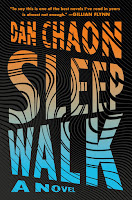
Sleepwalk by Dan Chaon

14 Comments »

With some authors, I know exactly what to expect before I read the first page of their book. That isn't to say that it is a bad thing. In fact, sometimes I read a specific author because I know what I will get with their writing. Some authors, though, are more chameleon-like in their work. Each book marks a new exploration of genre, character, and style. Author Dan Chaon is one of those authors. His 2017 novel Ill Will left me craving even more from the inventive author, and I was happy to accept his latest Sleepwalk from his publisher. 

Who is Will Bear? It is hard to describe precisely who he is or what he does, and that's exactly the way Will wants it to be. He's a man of mystery, the kind of guy who prefers to live his life under the radar. Will has countless aliases that help him maintain his anonymity. At fifty years old, he's perfectly content traveling around the county in his camper van, accompanied by his rescue dog, the only living thing he can truly trust. He makes money by completing dangerous, legally questionable tasks for an underground agency that he's perfectly content with knowing nothing about. In his line of work, connections can be dangerous, so he stays off the grid. Will is troubled when his numerous burner phones begin ringing and the person on the line asks for him by name. Even more troubling, the person on the phone is claiming to be his biological daughter. This is not the kind of baggage a man like Will needs. 

Only an author as adept and courageous as Dan Chaon could write a book like Sleepwalk. I've learned to expect the unexpected with his writing, and this newest novel is no exception. It reads like an epic journey akin to The Odyssey or Don Quixote twisted up with a mind-bending Hunter S. Thompson-like slant. There are many stops along the way that allow the main character Will to reckon with his past and determine which direction his future will take. It isn't always clear that there is a defined endpoint to the expedition, but it is to Chaon's credit that the reader doesn't really care. The fun is in the discovery of this masterfully written character and the various elements that have brought him to this point in his life. Setting the work in the not-too-distant future only enhances the hallucinatory, familiar yet unfamiliar quality of the writing. Sleepwalk is perhaps the most satisfyingly original novel I've read this year and a worthy addition to your summer reading list. 

For more information visit the author's website, Amazon, and Goodreads

(2022, 24)

The Warehouse by Rob Hart

4 Comments »

"Remember, freedom is yours until you give it up"

If ever there was a book that perfectly captured the predicaments of our modern times, it would be The Warehouse by Rob Hart. We face a time of massive technological advancement, political divisiveness, and the ever-mounting threat of a global climate crisis. With the reality of huge economic and social challenges looming over us, it seems as if we have turned inward to the technology that has become an essential piece of our day to day lives. In The Warehouse, Rob Hart imagines a not-too-distant future in which the above-mentioned instances have come to fruition.

A group of people is on a bus headed to one of the massive campuses that house Cloud. Cloud is the giant corporate conglomerate that has innovated its way to becoming the single largest means of commerce in the world. Think Amazon but on a much larger scale. At this point in history, Cloud is the singular provider of all consumer goods and most of the world's employment. Drones fill the sky delivering everything from bandaids to groceries. Each cloud campus has become a city of its own, housing all of the company's employees. If you work at could, you work, eat, and sleep on campus. Each person on this bus hopes to become part of Cloud's extensive ecosystem.

Two of the hopeful new recruits are Zennia and Patton. Patton has reluctantly decided to apply for a job with Cloud after his own small business was overtaken by the company. If you can't beat them, you might as well join them. Patton hopes to earn enough working for the company to eventually file for a new patent and become his own boss again. With the all-encompassing nature of Cloud, this will be extremely difficult to achieve. Zennia is much more reserved than Patton. She reluctantly reveals that she was a teacher before packing up her life to pursue a career at Cloud. Little does Patton know that Zennia is on a much more nefarious mission, the kind that could get them both killed.

When the publisher offered me a copy of The Warehouse to review, I was immediately drawn by the premise. Echoes of Eggers's The Circle and Orwell's 1984 ring through Hart's book. Hart roots his speculative fiction into a thriller that gives the narrative a momentum that helped to keep me engaged in the world he was building. Alternating perspectives between the two main characters give the reader insights into their motivations and makes the back and forth between the two all the more riveting. Interspersed between the main chapters are journal entries of Cloud's founder and CEO. With these, Hart illustrates the precarious balance between the well-intentions of large companies and the darker reality of what actually happens within them. The Warehouse is one of the most compelling books that I've read this year, a cautionary tale for our times that is an essential read for everyone.

For more information visit the author's website, Amazon, and Goodreads.
(2019, 30)


The Healer by Antti Tuomainen

8 Comments »

Ever since the massive success of Stieg Larsson's Millennium Trilogy, translated to English from its original Swedish, there has been an increase in translated novels to the American marketplace. And while some of these foreign authors have really resonated with the American public, think Larsson and Jo Nesbo, others seem to have been lost in translation.

In the Healer, a novel by Finnish author Antti Tuomaninen, poet Tapani Lehtinen navigates a post-apocalyptic Helinski, in search of his missing wife, Johanna. Johanna is a journalist who works for a newspaper that is struggling to maintain its relevance in this strange new world. Immediately before here disappearance, she was investigating a serial killer known as "The Healer". The Healer is known for murdering prominent businessmen, politicians, and their families, all because of their involvement in pursuits that harm the environment. As Tapani studies Johanna's research into the murders, he realizes that she was close to discovering the identity of The Healer. Now he worries that she is pursuing this known serial killer, or worse, The Healer is pursuing her.

This post-apocalyptic world, as imagined by Tuomaninen, falls in line with the bleak views that most of these European authors write about. Society has failed, medicine and doctors are hard to come by, and the police have been made obsolete by a lack of government, money, technology, and manpower. Therefore, the recover of Johanna falls on the shoulders of her husband, Tapani. As he investigates further into her disappearance, he uncovers secrets from her past that threaten to unravel everything he thought he knew about the woman he loves.

Despite the promising premise, I felt that the author was simply going through the motions on this one. I enjoyed the fast pace and entertainment value of the story, but any deeper meaning is either nonexistent or lost in the translation from the original text. There is never enough backstory or emotional depth to make any of the characters worth rooting for. In the end, the motivation behind The Healer's killings is almost laughable. It seemed that the author was trying to make some kind of political statement that comes across as misplaced within the context of the novel. Are we really supposed to believe that with all the chaos and corruption taking place and threatening lives, a person has decided to protect the environment? In this world where infrastructure has failed and disease threatens to spread at plague like speed, it is far more plausible that The Healer would be more concerned with saving his own life, rather than taking others for some political statement. Despite these shortcomings, I have to admit that the novel kept my attention, and I read it easily over the course of an afternoon. While it is not the pinnacle of foreign writing, it is an entertaining read that displays the promise of reading some of these translated novels.

For more information, visit the author's website, Amazon, and GoodReads.

(2013: week 20, book 18)


Powered by Blogger.